Computational Methods:

Simulating Filament in Fluid Stream

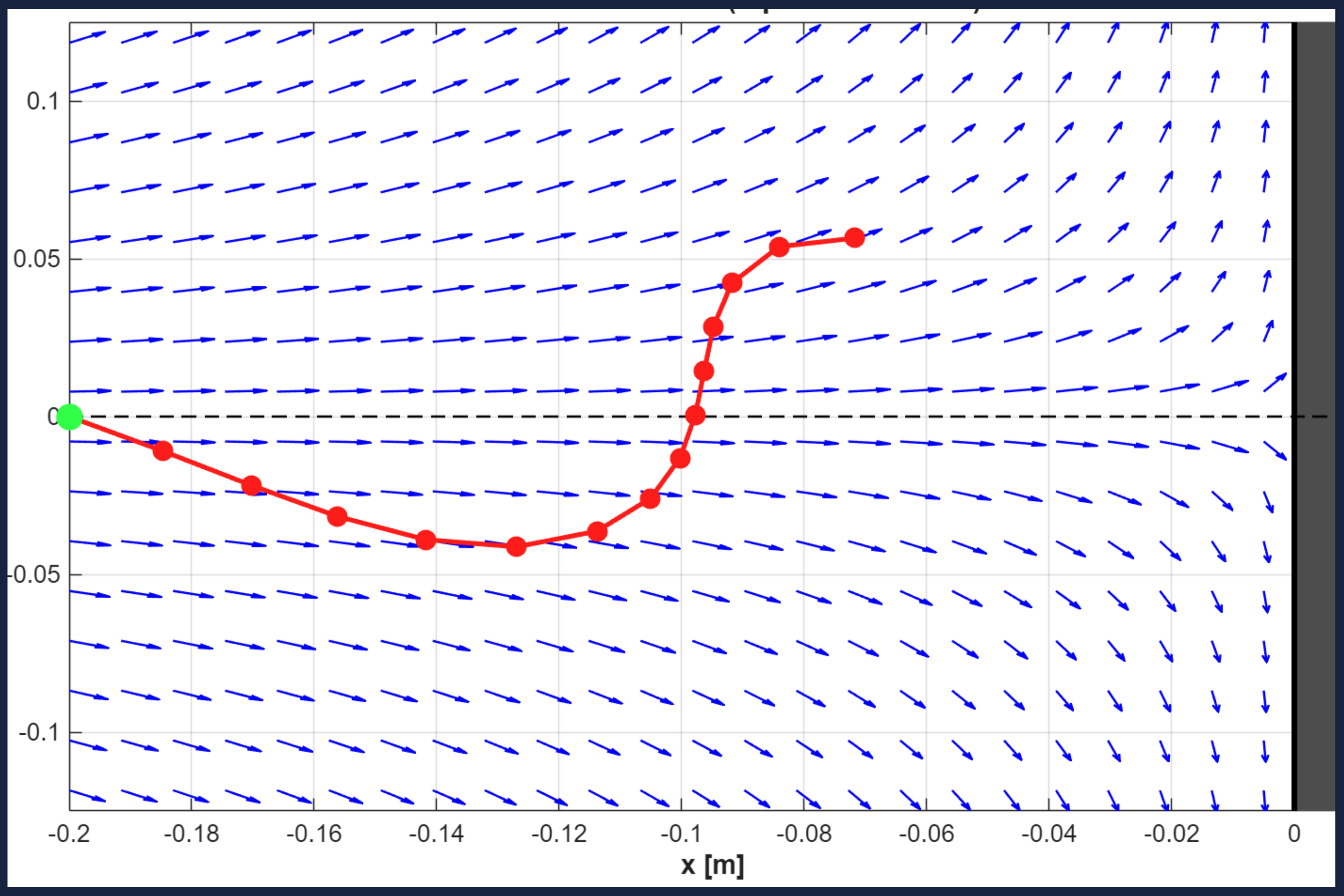
For my Computational Methods in Mechanical Engineering course, I worked on a MATLAB script to simulate an elastic filament in a corner fluid stream with base excitations.

This project showed me how programming and simulation can be used to solve real engineering problems.

Abstract

This project investigates the dynamic behavior of an elastic filament subjected to corner flow conditions and base oscillations. The filament is modeled as a series of discrete point masses connected by tension-only spring-damper elements and subjected to aerodynamic drag forces from a prescribed flow field. The equations of motion are integrated using the fourth-order Runge-Kutta method to capture the transient elastic response and fluid-structure interaction characteristics of the system. Simulations are performed for multiple excitation cases, including various oscillation amplitudes, frequencies, and flow field strengths. The numerical model reproduces the expected oscillatory motion and highlights the complex interplay between elastic forces, damping, and aerodynamic loading. These results highlight the applicability of high-order numerical integration techniques for modeling flexible structures in fluid environments and provide insight into filament extrusion processes relevant to applications such as electrospinning and fiber production.

Experience

This project gave me experience taking a theoretically mechanical problem and building it into a working numerical model. It reinforced my understanding of mass-spring-damper systems, RK4 integration, and fluid induced motion, while showing how small changes in systems can drastically alter dynamic behavior.

My primary role in this project was actually more focused in developing the physical model and governing equations, including force balances, drag equations, and other parameters, than it was actually building the program; which was where my partner shined. Beyond the initial setup, I also spent significant time running the program, fine tuning variables, and analyzing physical behavior to gain meaningful insights and effectively communicating my findings in the report.

Beyond this project, this course as a whole gave me a strong foundation in numerical methods and how they apply to engineering problems. Through topics like root finding, Gaussian elimination, interpolation, numerical integration, and differential equation solving, I gained experience using computational methods to solve problems that would be difficult or impractical by hand. It strengthened both my mathematical intuition and my ability to break down complex systems into solvable steps.
Project Report

Previous
Previous

RRC Storage